Growing visibility is supposed to increase pricing power. In many law firms and professional services firms it does the opposite. As recognition rises, client behavior shifts, negotiation increases, and margins compress. This is not a marketing problem. It is a structural one with direct implications for business valuation. This piece examines what that pattern looks like inside real businesses, what it costs at the valuation level, and what the four structural conditions of real pricing power are.
I came out of a client session recently with something I have been seeing more and more. The founder across from me had done everything right by conventional measures. Two years of consistent content. A recognizable name in the market. A calendar that was full three weeks out. Revenue was up. The team was stretched but engaged. And the firm was quietly earning less per piece of work than it had been before any of that growth started. Not because of bad hiring. Not because of inefficiency. Because the visibility had trained the market to treat the firm as a category option. And when you become a category option, price is how people decide.
A firm invests in visibility. Recognition increases. Inquiries grow. And gradually, the nature of those inquiries changes. More clients arrive having already decided what they want to pay. More conversations start with a fee question. More work gets accepted at margins that would have been turned away eighteen months earlier. Each decision looks reasonable on its own. The accumulation isn’t. This is the Pricing Power Trap. At the business level it shows up as declining margin health. At the client level it shows up as what I call the Negotiation Tax. When visibility expands faster than structural differentiation, clients begin negotiating before value has been established. The business does not notice until the margins begin to move. By then the decisions that created it are often years in the past.
Most founders assume that growth and pricing power move together. In practice, the mechanism that drives growth often works against the conditions that protect pricing. When a firm scales its visibility, it reaches a broader market. A broader market contains more price-sensitive buyers, more buyers who compare before they commit. Conversations start with a fee question instead of a problem description. The firm grows into a market that is structurally less aligned with the rates it is trying to hold.
Charlie Munger used to say pricing power is the single most important factor in evaluating a business. Not revenue growth. Not brand recognition. The ability to hold price without losing clients to a competitor. If you hesitate before raising your rates by ten percent because you are genuinely unsure whether the market will accept it, you do not have pricing power. You have presence. Those are different things and they produce different valuations.
Recognition tells the market you exist. Structural differentiation tells the market what it would cost them not to choose you. The first comes from marketing. The second has to be built into how the business actually operates, who it serves, and what it reliably delivers. When I look at a law firm or a professional services business closely, I am not asking how well known it is.
I am asking how hard it would be to replace. How specifically it has defined the client it serves. How clearly its value shows up in documented outcomes rather than in how it describes itself. How genuinely costly it would feel for a client to move away. When those answers are strong, visibility helps. When they are weak, visibility accelerates pricing instability.

The third pattern shows up in firms running advertising across multiple channels for several years. As lead volume increases, the proportion of inquiries converting without negotiation declines. The advertising reaches more people who are less familiar with the firm’s specific value and more inclined to treat the engagement as a purchasing decision rather than a professional relationship. The firm was paying to accelerate a shift in client mix that was quietly working against the margins the business depended on. More visible. More negotiated. Less profitable per unit of work.
In each of these three cases the business was not in crisis. It was in drift. And drift hides inside growth until it cannot anymore.
When pricing softens, most firms increase visibility. The assumption is that the market does not yet understand the value and that more exposure will correct it. This is the most common way the Pricing Power Trap accelerates. Warren Buffett described the protective condition as a moat. Something that makes the business genuinely hard to compete with. In law firms and professional services businesses, that moat is not built by marketing.
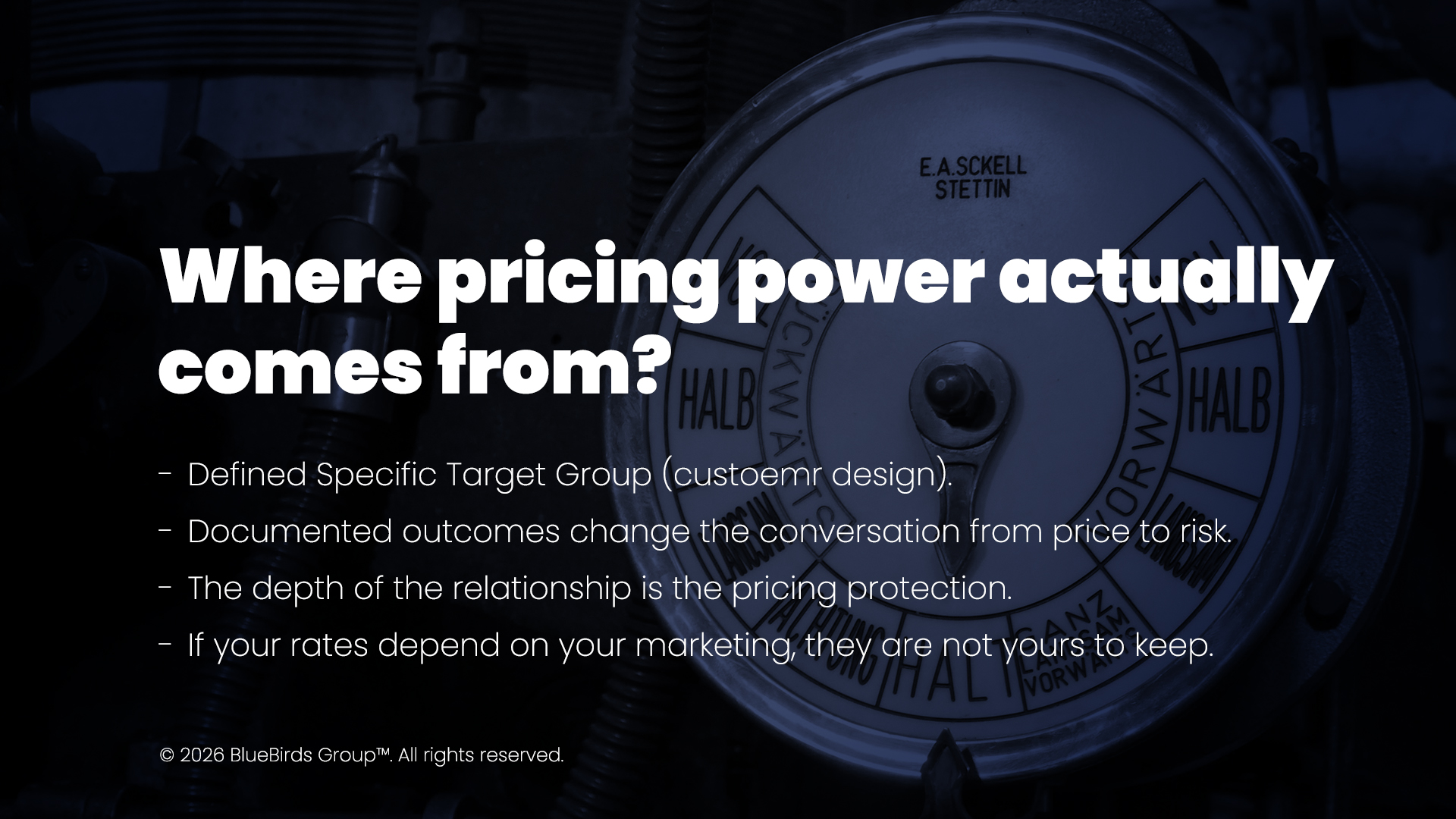
When pricing power is real, four conditions are always present. Not in theory. In the actual structure of the business.
The first is specificity. Not positioning language. Real constraint in who the firm serves and what problem it solves. Generalists get compared on price. Specialists get chosen on fit. That shift requires an honest decision about which clients to stop serving in order to be genuinely excellent at serving the ones who remain.
The second is documented outcomes. Not claims. Evidence that changes how clients make decisions. When a firm’s differentiation lives in specific, verifiable, client-described results, a prospective client is no longer comparing options at different price points. They are assessing the risk of moving away from something that has demonstrably worked.
The third is the cost of leaving. Not contractual. Relational and operational. When a client has invested significant time, shared sensitive information, and built genuine working trust with a specific advisor or team, they face a real cost in starting that relationship over. That cost belongs to the firm’s structural pricing protection whether the firm has recognized it or not. Most firms have more of it than they realize. Almost none build around it deliberately.
The fourth is independence from the founder’s visibility. Pricing that holds even when the founder steps back. Peter Thiel described the ideal condition as building something where the question of price becomes secondary to the question of access. A firm whose rates are held in place by the founder’s continued visibility carries transfer risk that a firm whose rates are held in place by institutional differentiation does not. These are not the same business. They do not carry the same valuation.
The first is in brand and market power. More inquiries begin with price questions instead of problem descriptions. Conversion rates on premium engagements decline. Recognition is rising while replaceability is rising alongside it.
The second is in business model integrity. Average realized rates decline while lead volume increases. The firm is accepting more work at lower margins to maintain volume. The client mix has shifted toward price-sensitive buyers without anyone deciding to make that shift.
The third is in financial reality. Cost to serve stays flat or rises. The gap between revenue growth and margin health widens. The business is growing its top line while compressing what it earns on each individual engagement. When I trace it back, it usually lines up with when visibility started scaling.
When the underlying differentiation is genuine, growing visibility breaks this cycle outward toward larger margins and stronger pricing. When it is primarily in presentation rather than in structure, visibility accelerates the cycle inward toward pricing instability and valuation compression.
A business that finds this pattern while it is still early drift has real choices that a business in late-stage compression does not. It can reorient toward a more specifically defined client with a more specifically defined problem. It can document outcomes in ways that create genuine switching costs. It can close the gap between what the brand implies and what the operational reality delivers. Most firms only realize this when those options are already gone. The businesses I find most worth working with are not the ones in trouble. They are the ones where the quality is genuinely there but the structure underneath has not yet been built to protect and scale it. The gap between what those businesses are worth and what they appear to be worth is where the work begins.
The question worth asking honestly
When a prospective client finds you and looks at your rates alongside alternatives, what is it specifically about your business that makes your price feel structurally justified rather than just competitively positioned?
Not in the marketing language. In the actual evidence of specificity, documented outcomes, and structural irreplaceability.
If the honest answer is less clear than it should be, that is not a marketing problem. It is an architectural one with direct consequences for what the business is worth.
If you recognize this pattern in your firm, the question is not whether it exists. The question is how far it has already progressed and what it is costing you at the valuation level.
Visibility is an amplifier. If the structure is strong, it strengthens pricing power. If it is weak, it accelerates margin erosion and valuation compression.
Most founders build recognition first and structure later. That sequence creates the Pricing Power Trap.
The firms that reverse it end up with something genuinely hard to replace. Harder to compare on price. More stable under founder transition. And worth significantly more when it comes time to sell, raise capital, or bring in partners.
That’s the difference between a business that grows and one that actually holds value.

Aaron Sed is the founder of BlueBirds Group™, a valuation intelligence firm. He developed the BVEA™ framework to help founders and leadership teams identify structural fragilities that quietly reduce enterprise value. His work bridges brand power, business architecture, and operational resilience so businesses become more durable, transferable, and easier to trust.
This site uses cookies to offer you a
better browsing experience.