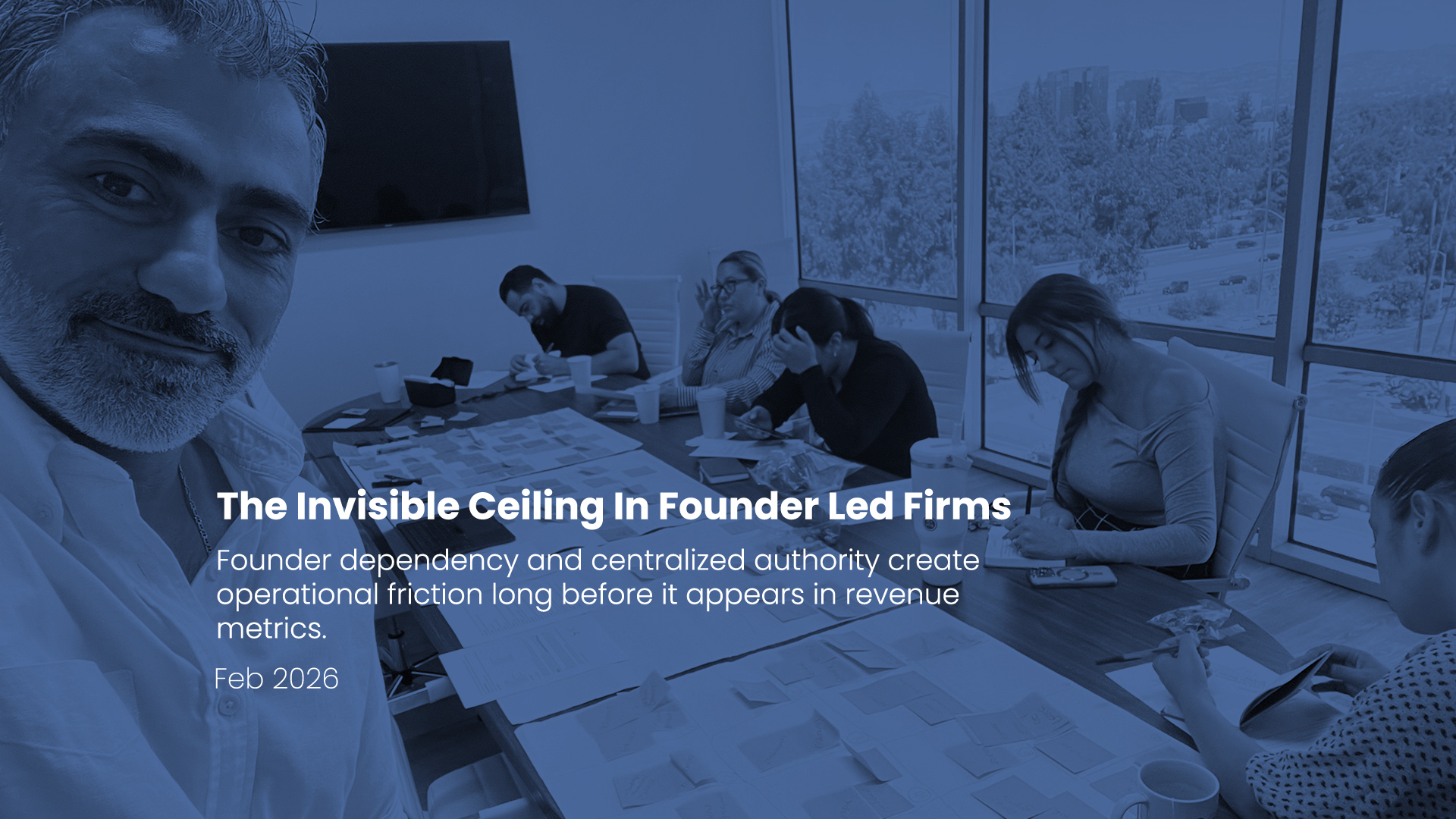
Many founder-led professional firms appear stable on the surface. Steady revenue, strong reputation, continuing referrals, yet internally experience a slowing velocity that rarely gets named. This piece explores the subtle yet meaningful impact of authority concentration and decision gravity on operational friction, perceived risk, growth optionality, and long-term value creation. Through real examples across law and professional services, and grounded in organizational and valuation research, we reveal why the constraint is often architectural, not external, and how structural clarity supports durable, investable value.
The Invisible Constraint. When Growth Becomes Heavy
There is a stage many founder-led firms reach but rarely articulate. Revenue is stable. Reputation is solid. Demand exists. Yet something feels heavier. Not dramatic, just slower. More decisions route upward. More approvals pause. More authority concentrates on one person. From the outside, everything looks fine. Inside, decision gravity is building. Too often, firms assume the constraint is marketing more visibility, more leads, sharper messaging. But demand isn’t the issue.
Authority Concentration, Trust, and Decision Velocity
In several firms we have reviewed across professional services, including immigration and personal injury practices, marketing was not the constraint. Demand was present. Capability existed among the team. Trust was high but concentrated.
Example 1-Immigration Practice: Intake volume was strong. Yet certain files stalled until the founding partner personally reviewed them. Associates were competent, but final judgment calls waited.
Example 2-Personal Injury Firm: Settlement negotiations beyond a threshold routinely escalated upward. Even senior associates with deep understanding paused before acting.
Example 3-Litigation Boutique: Hiring decisions repeatedly delayed because “final alignment” required one voice.
None of these firms were failing. They were respected. But velocity was uneven. When trust lives primarily in a person instead of in a distributed decision architecture, growth demands more effort — and that effort compounds over time.
Organizational and Valuation Research Insights
Decision rights and role ownership clarity are well-established predictors of performance and scalability and are frequently examined in organizational research. McKinsey’s Organizational Health studies consistently show that structural clarity correlates with sustained performance over time.Edelman’s Trust research underscores that trust is a business asset but trust embedded in individuals does not scale like trust embedded in systems. This difference matters in valuation terms.
The Economic Pathway From Structural Friction to Discount Rates
Operational friction caused by authority concentration affects more than cycle times. It influences how risks are perceived by investors and buyers. The chain of impact is straightforward: Decision gravity → Operational fragility → Higher perceived volatility → Higher required return → Higher effective discount rate, Because markets care about predictability and transferability, not just revenue volume, this dynamic affects valuation outcomes even when headline performance metrics look healthy. Unlike superficial optimization, structural clarity makes value more durable and defensible under scrutiny.
When authority is centralized, decision velocity slows and operational friction increases. Structural clarity restores scalable value.
When the Constraint Is Internal, Not External
If you stepped away from the business for 60 days:
Would intake flow confidently?
Would high-stakes decisions be made without hesitation?
Would revenue conversion remain stable?
Would margin behavior be predictable?
If the honest answer is uncertain, the issue may not be visibility.
It may be gravity.
This pattern is not unique to legal practices. We’ve observed it in advisory firms, boutique agencies, and other founder-led services where reputation is solid but authority is concentrated.
Growth can continue while subtle structural drag increases risk and reduces optionality long before it shows up in the numbers.
Moving Forward, Reducing Gravity Through Architecture
The first step is recognizing structural patterns without bias or defensiveness. Too often, founders assume the limitations are external markets, competition, talent shortages when the friction is internal.
Reducing dependency on a single decision point and systematizing trust distribution can restore velocity, reduce operational risk, and strengthen how value is priced under scrutiny.
Architecture sustains what marketing amplifies.
Final thought
Growth that feels heavier than it should is not always a demand or revenue issue. It’s often an architectural and structural one.
When trust and authority are concentrated in individuals rather than in a scalable architecture, the result is subtle fragility that increases perceived risk and valuation discounts. Understanding where decision gravity accumulates and addressing it structurally is not about telling a better story. It’s about proving durable value.
Founder, BlueBirds Group™, a valuation intelligence firm that helps founders, boards, investors, and buyers understand, protect, and increase enterprise value by diagnosing risk and uncertainty before capital events.