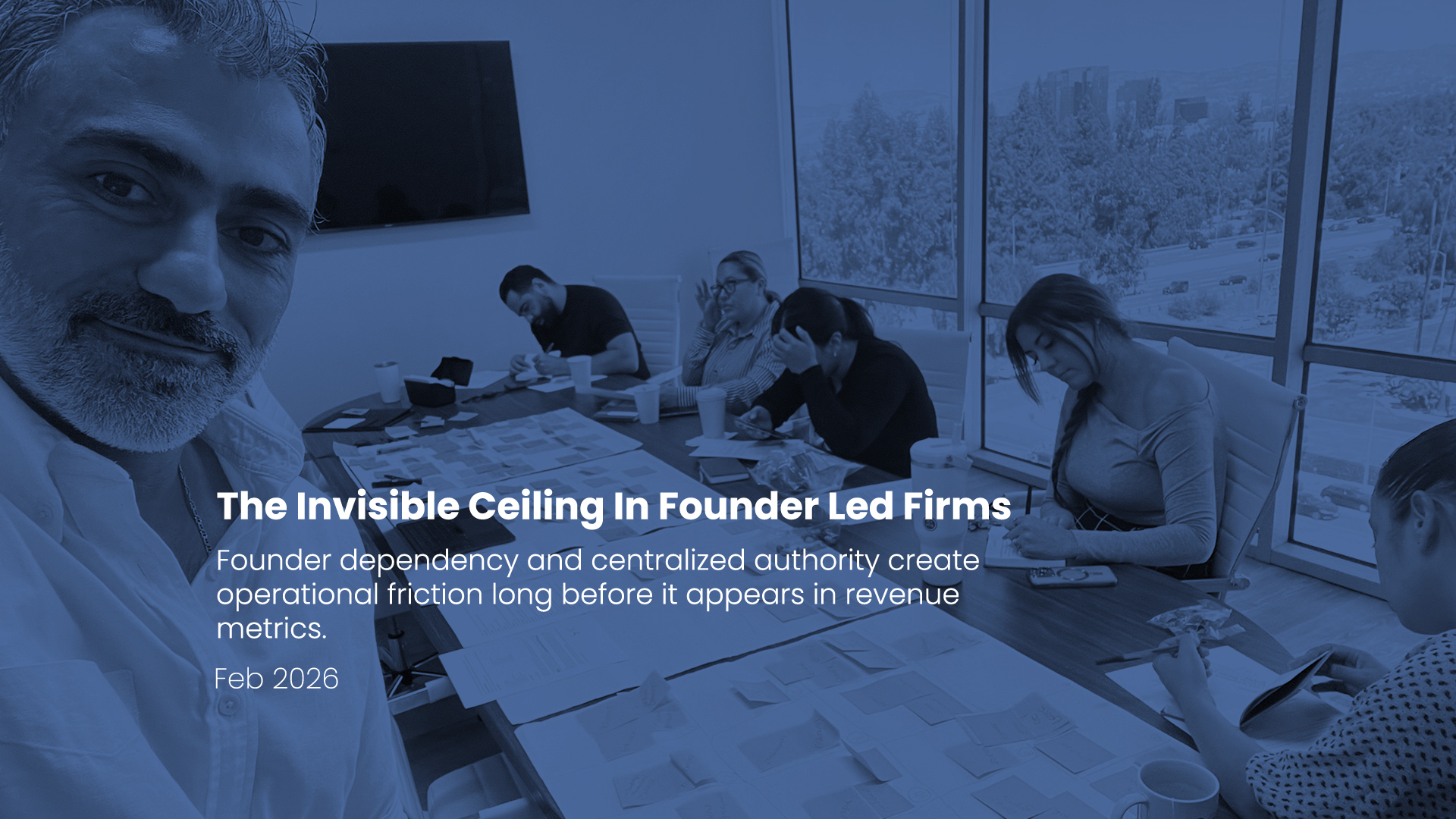
This article examines how misalignment between operations, client expectations, and leadership reality quietly transfers cost to leadership in professional firms.
When internal systems cannot reliably support what the firm promises externally, leadership compensates through personal involvement, judgment, and emotional labor.
Over time, leadership becomes the operating system, concentrating risk and eroding durability, transferability, and long term business value.
Through structural analysis and a real anonymized example, the article explores why messaging confusion is often the first visible symptom of misalignment, how dependency forms beneath strong performance, and the decision serious leaders must make between structural alignment and permanent compensation.
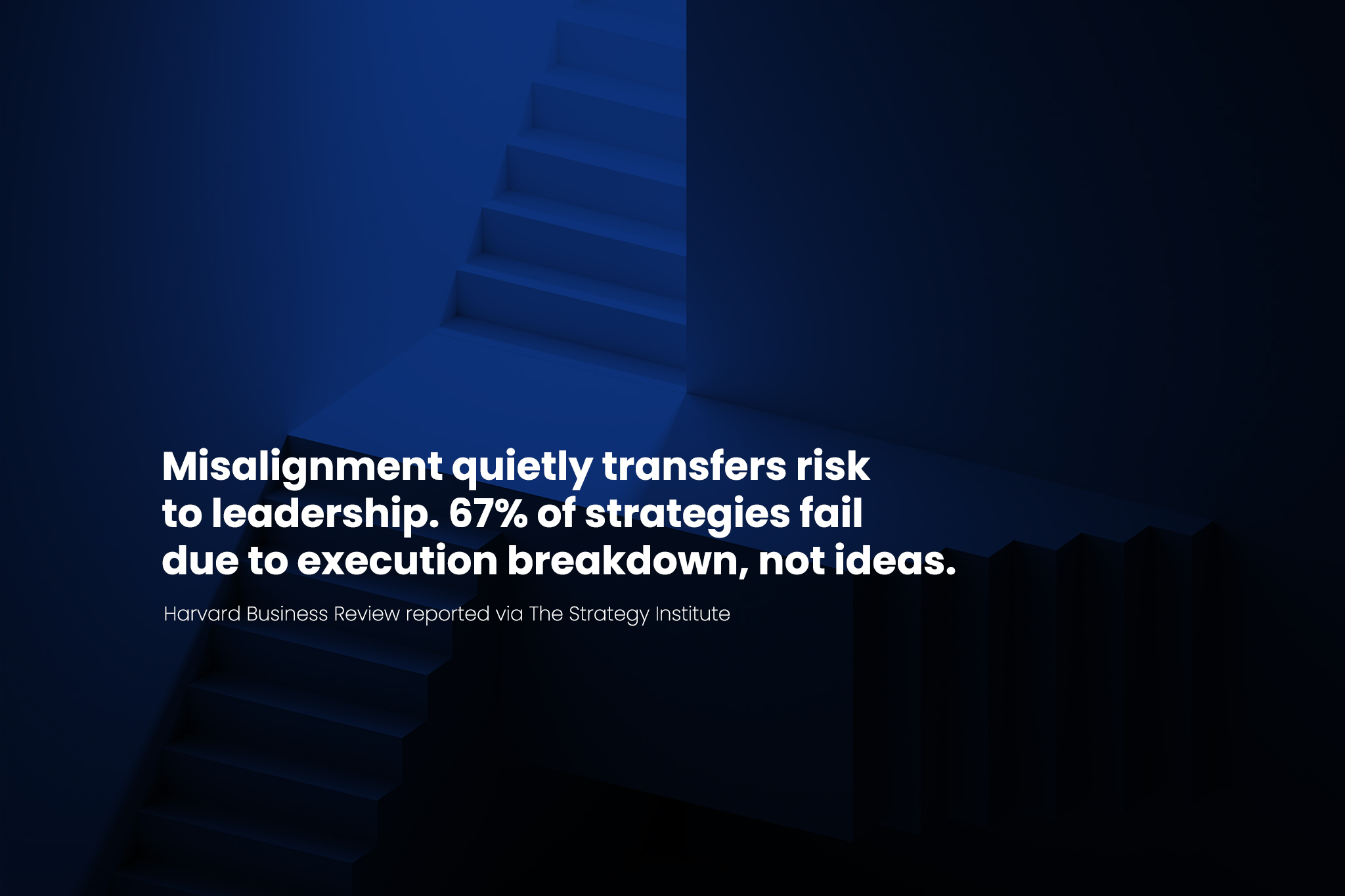
Most professional firms do not fail suddenly. They feel pressure first. The firm still works. Clients still arrive. Revenue still flows. But leadership feels heavier than it should. Communication becomes harder. Decisions stay concentrated in one person’s hands. The business begins to depend on individuals rather than on systems. This is rarely a matter of effort or integrity. It is a matter of alignment.
Misalignment does not begin with a crisis. It begins with good intentions. Operations evolve as the firm grows.
Client expectations rise with reputation. Leadership absorbs the difference so standards remain intact. At first, this feels responsible. The founder stays involved to protect quality. Leaders resolve edge cases personally.
Clients feel reassured by direct access. The business continues to function.
But beneath the surface, something important shifts.
Operations begin to rely on exceptions instead of structure. Client expectations are shaped by what leadership can personally deliver, not what the firm can consistently support. And the firm loses clarity about what it can credibly promise to the market. This is where alignment starts to break.
One of the earliest visible signals of misalignment is not declining results. It is confusion about communication. Firms hesitate to be specific. Positioning becomes broad, safe, and interchangeable. Messaging feels comfortable but undifferentiated. This is often misdiagnosed as a branding or marketing issue.
It is not.
When internal reality cannot reliably support a promise, specificity becomes risky. So firms speak in general terms. They describe capabilities that competitors can easily copy. Messaging confusion is not a marketing failure. It is a structural symptom.
When alignment breaks, the cost does not vanish. It transfers.
Over time, leadership becomes the operating system. This creates dependency disguised as involvement. From a business health perspective, this slows momentum. From a value perspective, it concentrates risk. A firm that relies on leadership to hold execution together may perform well today, but it becomes fragile at scale, during transitions, or under stress. Hidden risk is still risk. And risk is always priced into value, whether acknowledged or not.
A professional services firm we worked with was performing well on the surface.
Clients were satisfied. Cases moved forward. The firm’s reputation was solid. Yet leadership felt constantly stretched. Behind the scenes:
– Pricing decisions required founder approval
– Client reassurance depended on personal involvement
– Messaging remained intentionally broad
– Team decisions escalated upward more than necessary
Performance was not the issue. Dependency was.
After restoring alignment, the shift was not dramatic, but it was real. There was less need for personal intervention. The firm gained clarity about what it could genuinely promise. Internal escalation dropped. Leadership could step back without anxiety. No rebrand. No overnight growth spike. Just structural relief and clearer direction.
Very few organizations pause to ask questions like these:
These are not management questions. They are value questions. They reveal whether leadership is guiding the system or replacing it.
Every thoughtful owner reaches a point of choice. Either alignment becomes structural, or leadership becomes the permanent operating system. Both paths can keep the business running. But they lead to very different outcomes. One produces clarity, resilience, and optionality. The other produces dependency, pressure, and hidden fragility.
The difference is not effort. It is alignment. And alignment is a decision.
Firms that rely on leadership as the operating system may survive. But they do not scale cleanly. They do not transfer easily. And they quietly lose value over time. Healthy firms are not less involved. They are more aligned. They do not remove leadership. They make leadership optional.
That distinction separates short term performance from long term value. And it always starts with alignment.
Most firms do not lose value because they make bad decisions.
They lose value because too many decisions quietly rely on the same person for resolution, which weakens execution, slows agility, and obscures risk until it is too late. When alignment breaks, leadership fills the gaps. At first, that feels like responsibility. Over time, it becomes dependency.
Researchers have found that when strategy, structure, and leadership are not aligned, organizations experience uneven execution, delayed decisions, and reduced operational clarity even when results appear strong. The danger is not visible in revenue or reputation. It shows up in how much interpretation the system requires, how often reassurance replaces structure, and how much of the firm’s strength lives in someone’s head instead of the business itself.
As the example earlier in this article shows, restoring alignment did not instantly transform performance it reduced hidden dependency, clarified execution, and allowed leadership to build what came next. This is why alignment is more than an operational concern. It is a signal of business health and long term durability.
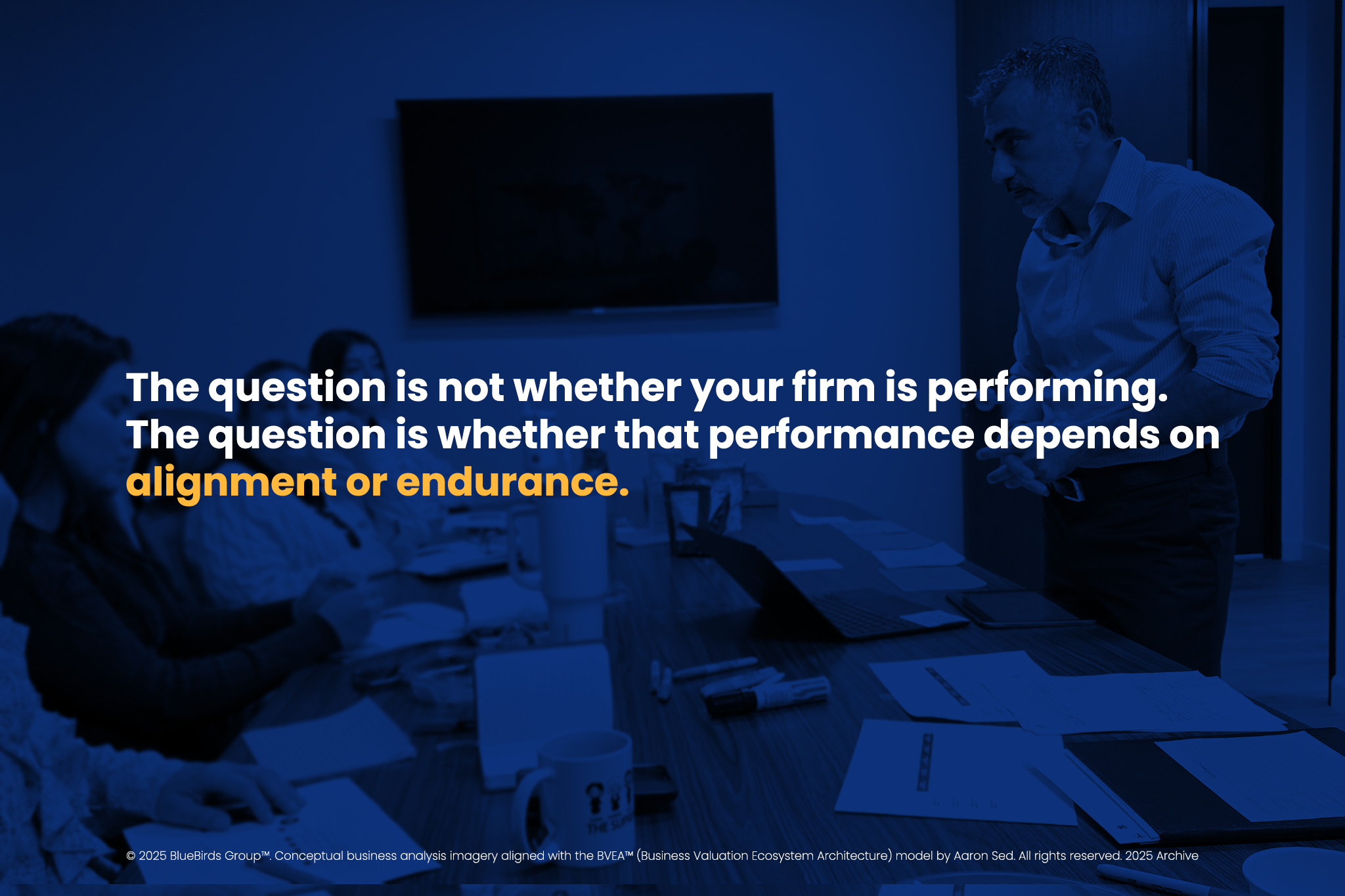
A healthy firm can explain itself clearly because it understands itself clearly. Its promises match its reality. Its systems carry weight. And leadership can operate from choice rather than constant compensation. The question is not whether your firm is performing. It is whether that performance depends on alignment or endurance. That distinction is subtle. But over time it defines durability, optionality, and value.

Aaron Sed is the founder of BlueBirds Group, specializing in bridging brand and business strategy to boost valuation and reduce failure risks. Certified by Marty Neumeier, Aaron works with founders and leaders to build aligned brand value ecosystems that drive sustainable growth and investor readiness.
Ref:
https://thestrategyinstitute.org/insights/from-strategy-to-execution-why-even-great-models-fail-without-alignment
This site uses cookies to offer you a
better browsing experience.